Lao Cai province's educational infrastructure
In recent years, Lao Cai province's educational infrastructure has been invested synchronously, gradually modernized, meeting the requirements of fundamental and comprehensive innovation in education and training. Many schools have been newly built and upgraded, especially in remote areas and ethnic minority areas, helping students have better learning conditions. The increasingly complete infrastructure system has created a solid foundation to improve the quality of teaching and learning, contributing to the development of human resources to serve the cause of industrialization, modernization and integration of the province.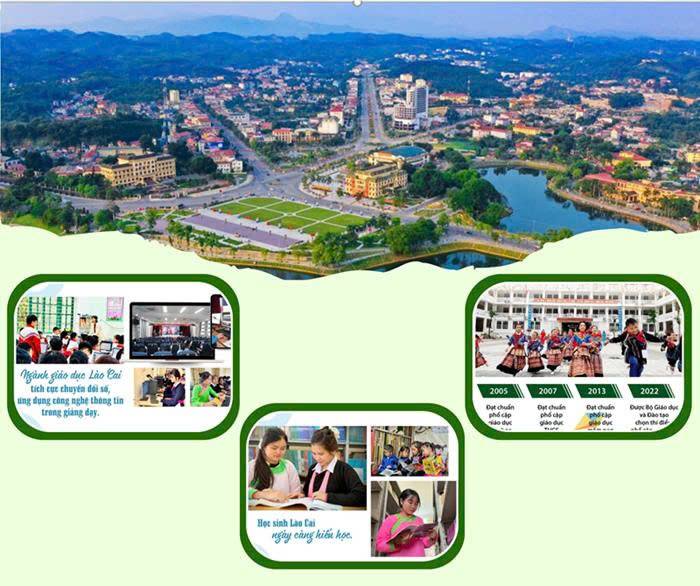
Lao Cai Education Sector is growing more and more
In the 2024-2025 school year, the whole Lao Cai province has 1,046 educational establishments, including 1,015 public schools and 31 non-public schools, with a scale of 15,317 groups and classes, 470,163 children/students/trainees, basically keeping the number of schools stable compared to the previous school year. Of which:
* Preschool education
The whole province has 370 kindergartens (343 public schools, 27 non-public schools) with a total of 4,306 groups and classes; 109,253 children attending class.
* General education
- Primary education
The whole province has 221 independent primary schools and 181 secondary and high schools; with 6,045 classes and 168,932 students.
- Secondary education
The whole province has 363 schools at the junior high level, divided into: 181 primary and secondary schools, 182 junior high schools; with a total of 3,520 classes and 130,518 students.
- High school education
The whole province has 68 schools (66 public schools, 02 non-public schools), divided into 14 junior high schools, 52 high schools, 02 middle schools with a total of 1,188 classes and 49,955 students.
- Vocational education and continuing education
The province currently has 21 vocational and continuing education facilities. Of which, 03 vocational secondary schools (including 02 non-public schools: Bach Khoa secondary school, Apatit secondary school), 18 continuing education and vocational education units (including 01 Provincial Education Center; 01 Lao Cai Center for Continuing Education and Vocational Training, 16 Vocational Education and Continuing Education Centers). With a total of 258 high school continuing education classes, 11,505 students.
* Higher Education, Vocational Education
The whole province currently has 03 professional and university educational institutions, including 01 branch of Thai Nguyen University with 2,574 students and 02 colleges (Yen Bai Vocational College and Lao Cai College), with 305 classes, 5,627 college and intermediate students.
* Students' learning and training results
- Students' training results increase gradually with each school year (Good training ranking for 6th graders in the 2024-2025 school year reached 80.19%, an increase of 4.1% compared to the 2021-2022 school year; 10th graders reached 85.9%, an increase of 5.18% compared to the 2022-2023 school year).
- Students' learning outcomes have many positive changes (Academic rankings for the 2024-2025 school year of 6th graders: Good is 9.4%, up 2.21%, Fair is 36.3%, up 2.59% compared to the 2021-2022 school year; Good is 14.36%, up 1.42%, Fair is 50.1%, up 7.32% compared to the 2022-2023 school year).
* Exam results at all levels
- Organizing high school graduation exams in 2025
In 2025, the whole province will have 59 examination sites and 817 examination rooms (including 02 examination sites for independent candidates taking the 2006 Program with 22 examination rooms). Number of candidates registered for the exam: 18,661; of which: Candidates registered for the exam under the 2018 General Education Program: 18,149 (of which 205 independent candidates have graduated); Candidates registered for the exam under the 2006 General Education Program: 512 (of which 503 candidates have graduated). The organization of the exam and grading of the 2025 high school graduation exam will ensure safety, seriousness, and compliance with regulations. The whole province has no cases of exam invigilators or candidates violating the exam regulations. The police, health, youth union and local functional agencies have closely coordinated with the Department of Education and Training in organizing the exam. The high school graduation rate of the whole province reached 99.1%. Of which: The old Yen Bai province reached 99.03% (high school reached 99.8%, continuing education reached 96.3%, independent candidates reached 57.14%). The old Lao Cai province: 99.27% (high school reached 99.59%, continuing education reached 97.35%, independent candidates reached 50%).
- Results of excellent student exams at all levels
The national excellent student selection exam in Lao Cai province won 128 prizes (old Yen Bai 57 prizes, old Lao Cai 71 prizes), including 02 first prizes, 16 second prizes, 45 third prizes, 65 encouragement prizes (an increase of 25 prizes compared to the 2023-2024 school year); 01 student in Informatics (student Nguyen Huy Phong) won a bronze medal at the Asia-Pacific Informatics Olympiad; won 6/6 prizes at the 2025 National Science and Technology Research Competition (old Lao Cai 3 prizes, old Yen Bai 3 prizes); of which, (03 second prizes, 01 third prize, 2 promising prizes) an increase of 01 second prize compared to 2024. In addition, Lao Cai students participated in other useful playgrounds and achieved encouraging results.
* Team of teachers and educational administrators
In the 2024-2025 school year, the entire education and training sector of Lao Cai province has 31,192 civil servants and employees (including 2,715 managers, 25,588 teachers, 2,889 staff). Specifically divided into:
- Preschool education: There are 9,949 officials and employees (including 1,004 managers, 8,125 teachers, 820 staff ).
- Primary education: There are 10,054 officials and employees (including 754 managers, 8,741 teachers, and 559 staff).
- Secondary education: There are 7,639 officials and employees (including 724 managers, 6,036 teachers, and 879 staff ).
- High school education: has 2,855 officials and employees (including 185 managers, 2,299 teachers, 371 staff).
- Vocational Education and Continuing Education Center: has 695 officers and employees (including 48 managers, 387 teachers, and 260 staff ).
At the same time, the entire career is still short of 1,956 civil servants and workers compared to the number of workers assigned by competent authorities in the year ( Specifically: Preschool is short of 426 people; Primary school is short of 858 people; Secondary school is short of 291 people; High school is short of 381 people ); short of 3,531 people compared to the regulations on teacher/class norms ( Specifically: Preschool is short of 787 people; Primary school is short of 1,102 people; Secondary school is short of 1,180 people; High school is short of 462 people).
* Universal education work by 2025:
- Maintain universal literacy results; aim to universalize preschool education for children aged 3-5 by 2030
+ By the end of 2024 until the time before the merger (June 30, 2025), with the participation of all levels and branches of the Steering Committee members; Lao Cai province continues to maintain and gradually improve the quality of universal education and illiteracy eradication: the whole province has 319 communes, wards and towns (old Yen Bai 168 units; old Lao Cai 151 units); 18/18 district-level units (old Yen Bai 168 units; old Lao Cai 151 units) meeting the standards of PCGDMNT5T, meeting the standards of universal primary education level 3; meeting the standards of PCGD THCS level 2; of which: 199/319 commune-level units; 05/9 district-level units maintained the level 3 PCGD junior high school standards. Pilot implementation of PCGDMNT4T (Lao Cai before merger): 9 districts, cities, towns and 151/151 communes and wards completed the PCGDMNT4T pilot, reaching 100%.
+ From July 1, 2025, implementing the two-level local government model, indicators on universal education and illiteracy eradication of communes and wards are being reviewed and updated.
- Teaching Vietnamese to ethnic minority children before entering grade 1 according to Circular 23/2023
+ Implementing Circular No. 23/2023/TT-BGDDT dated December 11, 2023 of the Ministry of Education and Training regulating the teaching and learning of Vietnamese for ethnic minority children before entering first grade (Circular No. 23), the Provincial People's Committee has issued a Plan and Official Dispatch on the implementation of Circular No. 23 of the Ministry of Education and Training. The People's Committees of districts and the district-level Department of Education and Training have developed plans to implement the teaching and learning of Vietnamese for ethnic minority children before entering first grade, ensuring compliance with regulations and in accordance with the actual situation of the locality. Primary schools subject to Circular No. 23 have disseminated and disseminated to managers, teachers, and parents about the teaching and learning of Vietnamese for ethnic minority children before entering first grade; develop plans, develop strategies, arrange personnel and facilities, review student populations and fully prepare conditions within the school to organize Vietnamese language teaching for ethnic minority children before entering first grade.
+ The whole province has 294 primary schools with 764 classes, 22,015 students; the number of teachers participating in teaching is 378 people (of which the old Yen Bai province has 148 primary schools with 366 classes, 10,118 students; the number of teachers participating in teaching is 378 people; the old Lao Cai province has 146 primary schools with 398 classes, 11,897 students; the number of teachers participating in teaching is 405 people); the total number of children evaluated: 22,015/22,015 children, reaching 100%. Children are mentally prepared, ready to enter first grade; are familiarized with the environment, discipline, and activities of primary school; children are formed with 6 basic learning skills; form and develop listening, speaking, reading, and writing skills, ensuring that they meet the set goals and requirements; Children are happy and comfortable when coming to school, ready and interested in participating in classroom activities. The results of the children's learning and training process are fully recorded by teachers and discussed with parents and teachers assigned to teach first grade to continue to have content to guide children's training during the school year.
+ However, when implementing, there were no policies for teachers and children, so schools with boarding students had to mobilize parents to contribute money, rice, firewood or advance from food suppliers to organize cooking for children.
- Investing in facilities and equipment for disadvantaged areas, developing ethnic boarding schools and community learning centers
+ School year 2024-2025, Department of Education and Training Continue to advise the province to direct the acceleration of construction progress of classrooms, subject classrooms, and auxiliary works in the 2021-2025 period, and purchase teaching equipment. Up to now, school and classroom facilities have basically met educational activities and been effectively exploited and used, with the rate of solid classrooms reaching 86%.
+ Actively implement the Project on developing the system of ethnic minority boarding and semi-boarding schools for the period 2020-2025. The whole province has 17 ethnic minority boarding schools with 207 classes and 7,175 students, including: 06 junior high schools, 54 classes and 1,874 students; 03 high schools, 39 classes and 1,365 students; 08 junior high and high schools, 113 classes and 3,936 students; 175 ethnic minority boarding schools, 147 high schools with semi-boarding students, with 64,949 students enjoying support policies according to Decree No. 116/2016/ND-CP, Decree No. 66/2025/ND-CP; 13/17 ethnic boarding schools meet national standards, reaching 74.47%; 105/175 ethnic boarding schools meet national standards, reaching 60%.
+ During the school year, the Department continues to direct the improvement of comprehensive education quality in boarding schools for ethnic minorities, innovate teaching methods suitable for ethnic minority students, ensure the quality of teaching Vietnamese and ethnic languages. Focus on educating ethnic solidarity and ethnic culture for students; carry out specific educational activities. Direct units to continue to maintain and improve the effectiveness of previously implemented models; guide the implementation of a number of new models such as: "Boarding school raised by people - Food for children"; "Self-managed boarding students - Helping each other to progress"; "Creating preschool toys and utensils"; "Nutrition for children"; “Building Happy Schools”, “Smart Schools”, “Connected Classrooms”… School models linked to practice, with innovative teaching methods and forms, applying knowledge to practice, learning goes hand in hand with practice;… continue to receive consensus and participation from local authorities and people at all levels.
+ However, although facilities and teaching equipment, especially in the highlands, have received investment attention, there are still many difficulties, especially subject classrooms. Some educational facilities in the highlands have limited land area, due to the mountainous terrain, it is very difficult to expand the land area; or if compensation for site clearance is required, the cost is large and very difficult.
- Support preschool education in industrial parks and export processing zones
Lao Cai is a mountainous province with many economic and social difficulties. The scale of the province's industrial parks is small and not concentrated. Most of the workers in the industrial parks are local people. Therefore, the children of preschool-age workers in the industrial parks are studying at preschool education facilities in the area. The network of public preschools and classes in the area with industrial parks basically meets the learning needs of the people's children. The whole province currently has 81 children of workers and laborers working in industrial parks who are entitled to policies. Private preschools, groups and independent classes in the area with industrial parks, because they do not meet the regulations in Decree 105/ND-CP (with 30% or more of the children being children of workers and laborers working in industrial parks), are not eligible for policies.
- Developing inclusive and specialized education for people with disabilities according to the plan until 2050
The Department of Education and Training, the Department of Education and Training, and school units always pay attention to and create conditions for people with disabilities to access educational services, mobilize and receive students with disabilities to participate in inclusive education. Managers and teachers who teach inclusive education for students with disabilities all have qualified professional qualifications, are responsible, enthusiastic, love their jobs, and are dedicated to educating children with disabilities in inclusive education; basically, teachers who teach inclusive education for children with disabilities have been trained and regularly trained in professional skills, including training in inclusive education for children with disabilities. The Department of Education and Training, in coordination with UNICEF Vietnam, invited lecturers, experts in experimental research on special education, the National Center for Special Education, and the Vietnam Institute of Educational Sciences to train teachers on inclusive education.
Educational institutions, teachers and staff always create the most favorable conditions for children's learning; create regular relationships with families to coordinate the care and education of children, as well as create conditions to encourage children with disabilities to participate in learning and training; implement policies for preschool children and students with disabilities, mobilize children to go to school, children are cared for and supported in learning and living, regularly closely monitor and grasp their psychology, do not let discrimination and stigmatization occur in schools.
Policies on tuition exemption and reduction, and support for learning costs for students with disabilities are implemented promptly by schools, ensuring full and correct regimes. In the 2024-2025 school year, there will be 3,640 students with disabilities studying in integrated education (of which 2,016 students are from the old Yen Bai province; 1,624 students are from the old Lao Cai province), reaching 100% of disabled children of school age who are able to go to school and have the need to study, all of whom are given the opportunity to go to school. Each student with disabilities has a personal profile for teachers to monitor their progress between classes and levels; teachers teaching students with disabilities are entitled to preferential allowances according to regulations.
- Literacy eradication: In recent years, Lao Cai province has actively and synchronously implemented solutions to maintain and improve the quality of literacy eradication work. In 2024, the whole province opened 85 classes with 1,983 students. In 2025, 71 classes were opened with 1,126 students./.