General information about Lao Cai province
On June 12, 2025, the 15th National Assembly approved Resolution No. 202/2025/QH15 approving the merger of Yen Bai and Lao Cai provinces, with the new administrative center to be located in Yen Bai Ward. Under the resolution, the newly formed Lao Cai Province will inherit the historical and cultural legacies of both localities while expanding its administrative scale to meet future socio-economic development and national defense demands. The merger is viewed as a strategic move aimed at streamlining the administrative system, improving resource allocation, and fostering sustainable regional development.
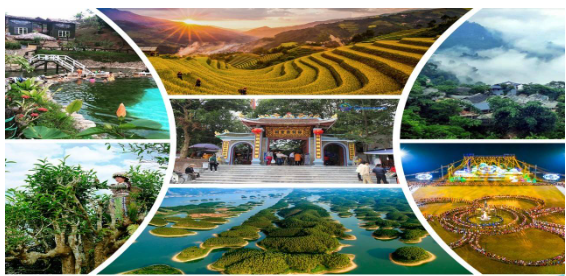
New Lao Cai province with administrative center and famous landmarks Thac Ba Lake, Sa Pa, Lao Cai International Border Gate, terraced fields
Historical origins of Lao Cai province
Lao Cai Province was first established on July 12, 1907, during the French colonial period. Following several administrative reorganizations, the 2nd session of the 5th National Assembly approved a resolution on March 27, 1975, to merge the three provinces of Lao Cai, Yen Bai, and Nghia Lo into a new administrative unit named Hoang Lien Son. On October 1, 1991, Lao Cai Province was re-established based on the territory of the former Lao Cai and was expanded to include three districts—Bao Yen and Van Ban (from the former Yen Bai) and Than Uyen (from the former Nghia Lo)—with a total of eight districts and two towns. The province continued to experience steady development throughout the following decades. Most recently, on June 12, 2025, the 15th National Assembly adopted Resolution No. 202/2025/QH15, approving the merger of the provinces of Lao Cai and Yen Bai, marking the establishment of the new Lao Cai Province.
Geographical location, population, terrain
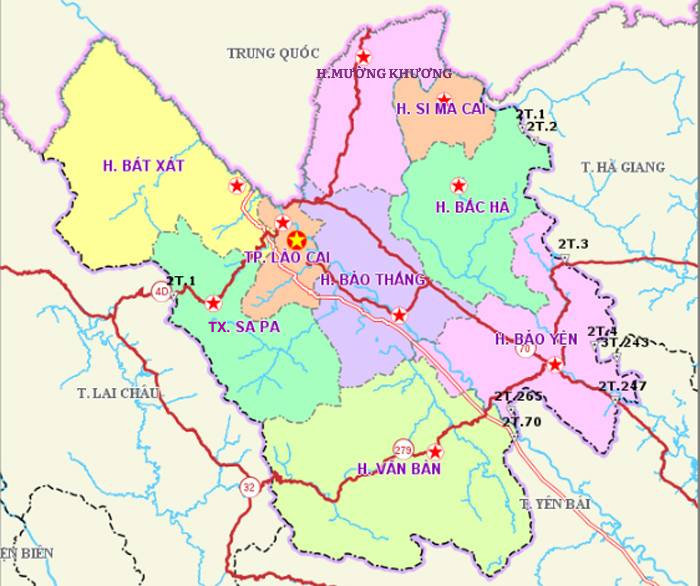
Lao Cai province is located between the Northeast and Northwest regions of Vietnam. Bordering Lai Chau, Phu Tho, Tuyen Quang, Son La provinces (Vietnam) and Yunnan province (China) with over 182km of border; area 13,256.92 km². Lao Cai province has 99 communes and wards (including 10 wards and 89 communes).
Population: 1,778,785 people (2025), of which ethnic minorities account for 61.1%.
In terms of terrain, Lao Cai has a complex terrain, high altitude stratification, influenced by the Hoang Lien Son and Con Voi ranges. In terms of climate, Lao Cai has a tropical monsoon climate, with two distinct seasons (rainy season and dry season) and fog is quite common. Lao Cai has many famous landmarks such as the Phan Si Pang peak on the Hoang Lien Son range at 3,143m high (known as the roof of Indochina), Mu Cang Chai terraced fields, etc. Lao Cai is an important ecological region for the whole country; has a strategic position and role in geopolitics and geo-economics of the country in economic exchange, foreign affairs, international cooperation with Yunnan province, the Southwest region (China) and ASEAN; an important gateway of the Kunming - Lao Cai - Hanoi - Hai Phong - Quang Ninh economic corridor; is the shortest and most effective sea route for goods from the Southwest - China market to the Southeast Asian and East Asian markets and vice versa.
Natural Resources
Rivers: Red River and Chay River are two main rivers flowing through the province, playing an important role in economic development and people's lives. Lao Cai has Thac Ba Lake, a large freshwater lake, playing an important role in hydropower development, irrigation, daily life and tourism.

As a province rich in mineral resources with over 35 types of minerals, over 150 mines of high value, large reserves and a strategy of combined exploitation and deep processing, Lao Cai's industrial production value in 2024 has reached over 45,000 billion VND, an average growth rate of over 20%/year, of which Apatite Ore has an explored reserve of over 2.5 billion tons, capable of providing long-term raw materials for phosphate fertilizer production facilities, contributing to the country's stable industrial development strategy; Copper Ore has a reserve of over 100 million tons, leading in Southeast Asia. Iron Ore has a reserve of over 120 million tons with Quy Sa iron mine, the second largest in Vietnam. In particular, Lao Cai is one of the few provinces with the largest rare earth reserves in the country.
History and culture
Historically, the old Lao Cai city was also the regional center. The scholar Le Quy Don in his book “Kien Van Tieu Luc” clearly recorded many roads from Lao Cai to Phong Tho to Lai Chau (later called the PaVi ancient road). From Lao Cai, the same route went to Van Ban to Than Uyen. From Lao Cai, there was also an ancient road to Khai Hoa prefecture of the Ming and Qing dynasties. On the other hand, the ancient road also connected Lao Cai with the Northeast region, including routes across the Chay River to the Tu Long Copper Mine area - Ha Giang. Lao Cai also had an ancient road to Bac Quang (Ha Giang), Ham Yen (Yen Bai).
According to many historical sources and research by famous historians such as the late Professor Tran Quoc Vuong, throughout history, in ancient times Lao Cai was the center of the ancient tribe of An Duong Vuong, before An Duong Vuong led his troops to Co Loa. Lao Cai was also a bustling urban area in ancient times. Historical documents recorded that in 1257, Tran Hung Dao commanded two naval and land forces to Lao Cai. In 1427, Le Loi sent talented generals to guard Le Hoa pass (today's Lao Cai border gate). Later, Lao Cai - Le Hoa pass or Bao Thang pass was also a very important border gate connecting our country with the Southwest region of China.
Since ancient times, Lao Nhai Street has become a bustling gathering and trading place for merchants, a place with long-standing historical relics (Thuong Temple, Tan Bao Pagoda, Mau Temple, Quan Temple, etc.). At the same time, this place was also an important administrative center during the French colonial period.
This strip of land is filled with secrets of the past, from ancient times. Archaeological results show that this is a land with a history from the Neolithic period to the Bronze and Iron Ages. The most typical one corresponding to the Son Vi Stone Age found in Mau A (a place name in the old Yen Bai province) is considered by archaeologists to be the site with the most outstanding characteristics. Along the river basin is the homeland of the Dao Thinh bronze jar, the nationally famous Hop Minh bronze jar and countless bronze artifacts discovered, buried by ancient people along the strip of land on both sides of the river. This land is also an area that still holds many mysteries full of memories of ancient residents, in dire need of exploration by scientists.
Cultural relics associated with legends are preserved by the people, the vestiges of communal houses and temples are also associated with historical events that happened on this land, such as Nhuoc Son temple associated with the names of Ha Bong and Ha Chuong during the period of fighting against the Yuan-Mongol; Dong Cuong temple (also known as Than Ve Quoc temple) associated with the Giap Dan uprising (1914) of the local Tay and Dao people against the French colonialists, Tuan Quan temple associated with the Yen Bai uprising in February 1930 of patriotic scholars who gathered here before starting. The administrative center of Lao Cai province, Yen Bai ward also stands out with the historical and cultural relic of the Ceremony Platform where Uncle Ho talked to the people of Lao Cai ethnic groups (old Yen Bai on September 25, 1958) in the center of the province, a familiar address to the whole country is the historical and cultural relic: Tomb of Nguyen Thai Hoc and patriots who sacrificed in 1930 in the Yen Bai uprising against the French colonialists, famous at that time, located in Yen Hoa park now in Yen Bai ward, Lao Cai province. There is also the Van Doc war zone during the resistance war against the French, there is Au Lau ferry which has become a historical and cultural relic of the locality.
Through historical periods from the French colonial period to the present, although with different names, Lao Cai province with its rich history, culture and favorable geopolitical and geo-economic position, Lao Cai city is increasingly developing.
Regarding housing, Lao Cai has many urban areas from medium to modern, especially social housing projects that have been and are being built, ready to meet the housing needs of officials, civil servants, public employees and workers.

In addition to investing in building many modern facilities, a large system of facilities and cultural - social institutions of regional scale has also been invested and put into operation, typically: In the field of education, there is the Canadian International School (the first international school in the Northwest region), Thai Nguyen University Branch in Lao Cai; in the field of Health, there is the high-tech building of the Provincial General Hospital (facility 2) which was inaugurated on February 24, 2025 with modern equipment to meet the needs of medical examination, treatment and health care for the people; in the field of culture, there is the Provincial Sports Competition Center which has hosted many international sports tournaments, typically the VTV Cup International Volleyball Tournament in 2023; Modern cinemas, museums, cultural centers, provincial libraries, etc. well meet the cultural and spiritual life of the people.
Strategic position in national defense and foreign affairs
With more than 182 km of border with Yunnan province (China), over the years, the Party's foreign affairs, state diplomacy and people's foreign affairs activities have been expanded; many models of twinning of border posts, border stations, villages and hamlets in border areas associated with border exchange activities and people-to-people exchanges have been promoted. Lao Cai ward and town are located in the center of the confluence of the Red River and Nam Thi River, which plays the role of the "Fence" of the Fatherland; becoming a trusted address in defense exchange activities between Vietnam and China over the years.
Lao Cai serves as a strategic gateway between Vietnam and Southwest China, a region of more than 400 million people and a key economic hub. The province provides a vital route for goods from Vietnam and other ASEAN countries to access this expansive market. The Lao Cai Border Gate Economic Zone—featuring modern industrial parks and logistics centers—has emerged as a significant magnet for investment. Its growth is helping to boost import–export activities and strengthen international trade links across the region.
The border between Lao Cai province and Yunnan province has been assessed as "A truly typical border that can be replicated across the entire Vietnam-China border" which not only promotes socio-economic development, ensures national defense and security, but also affirms the role of "fence" of the Fatherland. Lao Cai city (old), now Lao Cai ward, was recognized by the Chinese government as a "Friendship City with China", becoming a model among provinces with good traditional relations with Yunnan province (China). This is also the leading locality to complete land border demarcation (2007).
On the basis of the friendly and good cooperative relationship built in the recent period, Lao Cai has organized many activities of talks and signing comprehensive cooperation agreements between the Secretaries of Lao Cai and Yunnan provinces - China; Exchange conferences between the Secretaries of border provinces and the Secretary of Yunnan province... This is a long-term advantage for Lao Cai to become a reliable gateway and an important transit point for goods on the economic route of Kunming - Lao Cai - Hanoi - Hai Phong - Quang Ninh. Along with the achievements in foreign affairs activities, Lao Cai has many opportunities to be selected to build a cross-border cooperation zone with preferential policies, investment guarantees and optimal monitoring mechanisms to create conditions to expand the export market for goods of the region and the whole country.
The position and strength of Lao Cai province in terms of economy and society
The average growth rate of gross domestic product in the area reached 6.92%/year, 0.41 percentage points lower than the previous period, 0.62 percentage points higher than the national average (6.3%/year). The economic scale reached 142,599 billion VND, 1.63 times higher than in 2020. The economic structure shifted positively towards reducing the proportion of agriculture, forestry and fishery (from 19% to 16%), increasing the proportion of industry - construction (from 34.9% to 37.3%) and services (from 38.3% to 39.2%). GRDP per capita reached over 85 million VND, an increase of 29.9 million VND compared to 2020. Average income per capita reached 47 million VND, an increase of 17.3 million VND compared to 2020.
Industry continues to grow, affirming its role as an important pillar of the economy. The average growth rate is 7.29%/year. The value of industrial production in 2025 will reach over VND 75,000 billion, up 49.8% compared to 2020, contributing 29.5% to GRDP. The internal structure of the industry has shifted positively, the proportion of processing industry increased from 73.34% to 76.6%, the mining industry decreased from 7.38% to 5.5%. Focus on attracting investment, developing deep processing industry associated with the application of modern technology in the exploitation and processing of minerals, agricultural and forestry products. Focus on planning and investing in infrastructure of industrial parks and clusters (07 industrial parks in operation with an occupancy rate of over 77%, 21 industrial clusters with an occupancy rate of over 60%).
Trade and services grew positively. The average growth rate reached 8.17%, an increase of 2.03 percentage points compared to the previous period. Total retail sales of goods and social service revenue reached 85,000 billion VND, 1.89 times higher than in 2020, many new trade models in urban and rural areas came into operation. The border economic zone had its technical infrastructure upgraded, the digital border gate model operated effectively; the total value of import and export of goods was estimated at 4.0 billion USD, basically equivalent to the period before the Covid epidemic, making Lao Cai the second largest gateway for customs clearance of agricultural products to the Chinese market. The export market has been expanded, currently the province's products have been exported to 90 countries and territories, including many large and stable markets such as: USA, EU, India, Korea, Japan, China, Taiwan... Import activities mainly focus on groups of machinery, fertilizers, garment accessories,... serving the production of enterprises; thereby contributing to increasing the overall economic growth rate of the province.
Tourism has grown rapidly, gradually affirming itself as the province's spearhead economic sector. In 2025, it will welcome over 10 million visitors; revenue from tourism services will reach VND 46,455 billion, 2.4 times higher than in 2020. The province's tourism types and products such as sightseeing, resorts, eco-tourism, spiritual tourism, cultural tourism, and traditional festivals have recovered and developed strongly. Sa Pa National Tourism Area has been invested in, attracting many large projects in technical infrastructure and services. The natural potential and cultural identity of ethnic groups in Mu Cang Chai, Tram Tau, Nghia Lo, Bac Ha, Y Ty, Nghia Do... increase the attraction and competitiveness of the local tourism industry.
Finance and credit have grown well, meeting the needs of socio-economic development. State budget revenue in 2025 will reach 21,000 billion VND, exceeding the estimate assigned by the Central Government, 1.64 times higher than in 2020, meeting 52% of budget expenditure. Restructuring the budget towards savings and efficiency, increasing the proportion of development investment expenditure, reducing the proportion of regular expenditure. The number, scale and operating market of credit institutions continue to expand; mobilized capital from banks reaches nearly 100,000 billion VND, with an annual growth rate of 10-15%; outstanding credit balance reaches over 125,000 billion VND, with an annual credit growth rate of 10-14%, approaching the credit growth rate of the whole country. The bad debt ratio is at a safe level of below 3%. Total social development investment capital for the whole period reached over 360,000 billion VND, 2.2 times higher than the 2016-2020 period.
There has been much progress in cultural, social and human development: The whole province has 56 intangible cultural heritages, of which 3 have been listed by UNESCO in the list of representative intangible cultural heritages of humanity; 54 national intangible cultural heritages. The percentage of households, villages and residential groups meeting cultural standards is 85.5% and 77.5% respectively. The percentage of agencies meeting cultural standards is 77.5%. The percentage of people regularly exercising is 39.5%. The percentage of schools meeting national standards increased from 58.9% in 2020 to 75.6% in 2025; the percentage of solid classrooms reached 86% of the total number of classrooms; the percentage of boarding/semi-boarding student accommodation reached 45.67%. The percentage of trained workers increased from 64% to over 70%, of which the percentage with diplomas and certificates reached 25.3%; Social labor productivity increased by an average of over 6% per year.
Across the province, there are two Grade I hospitals and 19 Grade II hospitals and medical centers. A total of 315 communes, wards and towns (prior to the merger) met national healthcare standards, accounting for 98.7%. The province recorded 12.8 doctors and 38.1 hospital beds per 10,000 residents, and has introduced a range of new and advanced medical techniques. The average life expectancy has reached 72 years.
The average poverty reduction rate is 4%/year; to date, the remaining poverty rate is 5.71%. The socio-economic situation in mountainous, border, and ethnic minority areas has made much progress, gradually narrowing the gap between lowland and highland areas. As the first and only province in the country to build and implement the Happiness Index with many creative and effective methods, to date the happiness index has reached 68.3%.
Lao Cai is a land with many potentials and strengths in terms of geographical location, natural resources, culture and people. With the determination to innovate and develop comprehensively, Lao Cai province is gradually affirming its role as an important economic, tourism and border gate center of the Northern midland and mountainous region. Lao Cai today is not only an attractive destination for tourists and investors but also the pride of a land rich in tradition, firmly on the path of integration and sustainable development./.