Vocational training and job creation help ethnic minorities stabilize their lives.
Lao Cai prioritizes investment in education development, vocational training, and job creation for rural workers, particularly ethnic minorities, by effectively promoting capital from national target programs such as the National Target Program for Socio-Economic Development in Ethnic Minorities and Mountainous Areas. This establishes circumstances for ethnic minorities to have steady earnings and to alleviate poverty in a sustainable manner.With more than 18 thousand members, mainly ethnic minorities, many women in Sa Pa have taken advantage of the opportunity to develop the economy through activities such as homestay, brocade embroidery, and good agricultural production. In addition, more than 40 agricultural and tourism cooperatives along with many restaurants and hotels in the area have been creating jobs for local women. However, to promote this potential, it is necessary to have close cooperation from Party committees, authorities, associations and specialized sectors in supporting women in economic development; connecting to solve employment problems, creating conditions for women to rise up and take control of their lives.

Localities actively implement propaganda, counseling, and early career orientation for students.
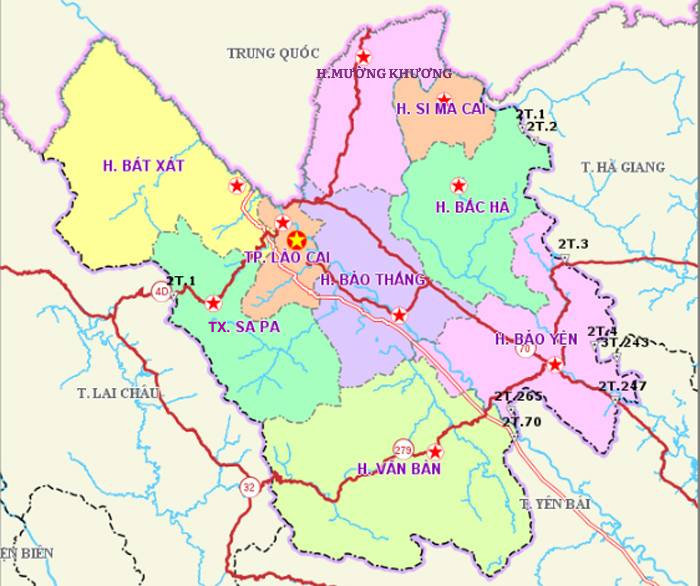
In other highland localities such as Simacai and Muong Khuong, creating local livelihoods for ethnic minorities has also received special attention. The positive changes here are clear evidence of the common efforts in improving the lives of people in the highlands.
In Simacai, with 56% of the population of working age, more than 80% of them work in the agricultural sector. However, the locality is facing a shortage of local labor, especially trained labor. Therefore, vocational training associated with employment becomes a key task.
From 2021 to the end of 2023, Si Ma Cai has organized more than 30 vocational training courses in the locality, helping nearly 1,300 workers improve their skills. The courses focus on practical occupations such as construction techniques, planting and caring for temperate fruit trees, and raising large livestock, etc., suitable for the needs of unskilled workers, contributing to creating stable jobs and improving the lives of people in the region.
To create more jobs for workers, Si Ma Cai district is directing communes to review and synthesize job search needs to support workers appropriately. At the same time, the district is stepping up propaganda, consulting, and job introduction in domestic industrial parks, coordinating with vocational training facilities and businesses to attract workers, from training to job placement and recruitment. Consulting sessions are held in local languages, helping people easily access information and choose suitable jobs, attracting a large number of people in villages and hamlets to participate.
Although the economy is recovering after the Covid-19 pandemic, Simacai still faces challenges in the field of labor and employment. The number of workers working outside the province is large, while the remaining local labor force is mainly the elderly and children, making it difficult to mobilize local economic development. To solve this problem, the district is implementing synchronous solutions such as streamlining, early career orientation for students and strengthening vocational training associated with job creation right in the locality.
Talking to us, Mr. Nguyen Trung Kien, Vice Chairman of the People's Committee of Si Ma Cai district said: " In 2024, Si Ma Cai organized 32 vocational training classes. The People's Committee of the district assigned relevant departments to select vocational consulting units and reputable vocational training organizations and enterprises in the province to bid and widely advertise to participate in vocational training to help people develop the economy right in the locality". According to statistics, Si Ma Cai district has nearly 8,000 workers working at production facilities in and outside the province. To continue to improve the effectiveness of job creation, the district will coordinate with the province's employment service units to promote and orient careers for high school students. At the same time, improve the quality of vocational training associated with job creation, helping local workers increase their income and stabilize their lives.
In Muong Khuong district, 63% of the population is of working age, mainly ethnic minorities. However, due to low education level and limited rate of workers with degrees and certificates, unskilled workers lack knowledge and skills, leading to low productivity and unstable jobs. Paying attention to vocational training and job creation is a key task of the locality to sustainably reduce poverty.
In 2023, Muong Khuong district organized 16 vocational training classes with 560 students. Of which, there were 3 non-agricultural classes (construction, electricity) and 13 agricultural classes focusing on tea planting and processing. The classes were held right in the village, helping farmers gain more knowledge, skills and the ability to apply techniques to production, improving productivity and economic efficiency. The district also directed departments, educational and vocational training institutions to coordinate with businesses to provide career counseling, find and connect jobs for workers. In 2024, vocational training will continue to be promoted. Notably, the Northern Mountainous Agricultural and Forestry Science and Technology Institute will coordinate with the People's Committee of Muong Khuong district to organize 7 tea planting and processing classes in 5 communes, each class has 35 students.
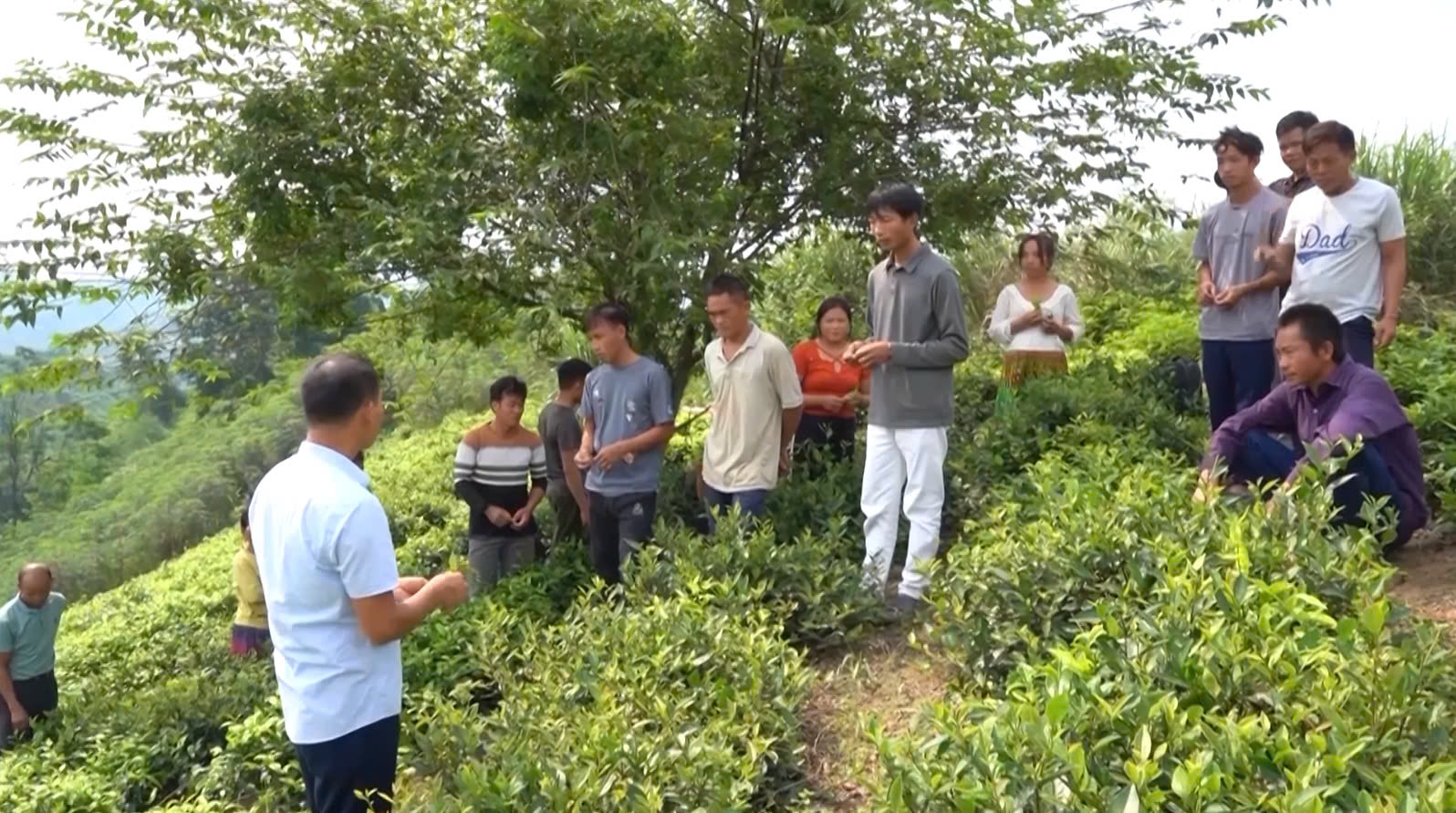
Training for Muong Khuong people on planting and caring for tea trees in the locality.
These classes provide farmers with basic knowledge about the origin and biological characteristics of tea plants, factors affecting growth, breeding techniques, planting, care, pest control, harvesting and preserving fresh tea buds, and tea roasting and drying techniques.
Since 2021, Lao Cai province has provided vocational training to more than 50,000 students, including 28,000 ethnic minorities. Vocational training institutions focus on training human resources in new occupations with high recruitment demand such as tourism - services, beauty care, electricity, and Chinese. The rate of students having jobs after graduation is over 75%.
During this period, more than 30,000 workers were trained and worked at enterprises and production facilities in and outside the province, with an average income of 7 to 10 million Vietnamese dong/person/month. Short-term vocational training courses not only provide knowledge and skills but also help people become more confident in applying science and technology to production, creating quality products and increasing income. Many students after participating in vocational training courses have found stable jobs, contributing to improving their lives and promoting socio-economic development in the locality.
Along with vocational training, Lao Cai province is focusing on building and perfecting the labor market data information system, focusing on forecasting labor supply and demand. Job fairs are held regularly, especially in communes with high poverty rates, to increase employment opportunities for workers.
In 2024, the province organized 96 job fairs, promoting labor and employment policies to more than 20,000 people. Thereby, connecting jobs for 780 workers. From the loan capital from the National Employment Fund, more than 4,400 workers were supported to create, maintain and connect jobs.
It can be affirmed that vocational training and job creation for workers in remote, isolated and extremely disadvantaged areas are given special attention by mountainous localities. Reality has proven that this is a direction that contributes to rapid and sustainable poverty reduction in the highlands. To implement this policy, Lao Cai province has had a policy to support vocational training for ethnic minorities. Notable among them are vocational training policies, according to the projects: Project "Vocational training for rural workers until 2020" according to Decision No. 1956 dated November 27, 2009 of the Prime Minister"; Project "Supporting women in vocational training and job creation for the period 2010 - 2015" according to Decision No. 295 dated February 26, 2010 of the Prime Minister. Vocational training policies through the projects have provided vocational training for rural people, equipped them with knowledge and techniques in agricultural and forestry production to improve productivity and product quality; developed processing and technical occupations to contribute to increasing income for people. In 2024, it is estimated that the whole province will have over 20,700 poor households, of which over 19,700 are poor households of ethnic minorities. This number has decreased by 6.19% compared to the previous year.
From now to 2025, Lao Cai province strives to train 10,400 rural workers; train 6,250 skilled workers; in the period of 2026-2030, strives to train 27,000 skilled workers. Innovating in vocational training, the province will organize vocational training classes for rural workers associated with training and fostering to improve digital skills for people; enhance the application of science and technology; digital transformation in all stages to meet the requirements of industrialization and modernization of agriculture and rural areas, creating momentum for comprehensive development of all aspects of socio-economic life. Thereby, contributing to improving living standards, narrowing the gap between regions, creating momentum to promote socio-economic development in ethnic minority areas./.