Strengthening the Party's leadership over social welfare
Social welfare is one of the important policies of our Party and State that has been thoroughly grasped and ensured to be implemented in the development periods of the country. In recent years, despite facing many difficulties and challenges, social welfare in Lao Cai continues to achieve many positive results, with policies are constantly improving, and the material and spiritual life of the people is being cared for better and better with the goal of "no one is left behind".Lao Cai has closely followed the requirements and contents of Resolution No. 15-NQ/TW and Conclusion No. 92-KL/TW dated November 5, 2020 of the Party Central Committee on continuing to implement the Resolution of the 5th Central Conference, Session XI. The Party Committee of the Provincial People's Committee has advised the Provincial Party Committee to issue action programs, and the Provincial People's Council to issue Resolutions and direct the Provincial People's Committee. In particular, the Party Committee of the Provincial People's Committee has issued Directive 06-CT/TU dated January 13, 2021 on continuing to strengthen the Party's leadership over social welfare in Lao Cai province.

Lighting candles to pay tribute to heroic martyrs at Nam Cuong cemetery, Lao Cai city on War Invalids and Martyrs Day, July 27.
Lao Cai has properly implemented preferential policies for people with revolutionary contributions. Currently, the province has more than 25,000 profiles of people with revolutionary contributions; more than 13,000 households of people with revolutionary contributions, of which more than 3,000 people receive monthly allowances. In the past 10 years (2013-2023), the state budget for preferential treatment for people with revolutionary contributions has increased every year. The work of confirming profiles is ensured to be correct in terms of conditions, order, and profile procedures according to regulations in current documents.
Every year, Lao Cai province issues nearly 17,000 health insurance cards to meritorious people, soldiers, veterans, and youth volunteers; 100% of meritorious people who have reached their retirement age are entitled to health care and rehabilitation benefits, and are provided with orthopedic assistive devices.
The movement to mobilize the "Repaying gratitude" Fund has always received attention and contributions from all levels, sectors, agencies, units, social organizations and individuals inside and outside the province. Thanks to that, in the period of 2013-2023, the "Repaying gratitude" Fund at all levels has mobilized nearly 55.5 billion VND. The fund is managed and used to support house building and repair for meritorious people, visit and support families of meritorious people with difficult circumstances in life...
Combining the central budget and local budget, Lao Cai province has developed a housing support project for people with meritorious services and has completed support for 2,680 households, with an implementation cost of more than 96 billion VND. From the source of support for the "Repaying gratitude" Fund in the period from 2013-2023, the whole province has supported housing for 1,024 households of people with meritorious services, with a cost of more than 36.5 billion VND. Following housing support policy for poor and near-poor households under the National Target Program for the period 2021-2023 and population arrangement under Decision No. 590/QD-TTg, Lao Cai has supported 1,815 houses. In addition, housing support is implemented for low-income people in urban areas. In 2023, Lao Cai province approved a plan to build 05 social housing projects with a land area of about 14.22 hectares such as: Social housing project being invested in Sa Pa town, social housing in Lam Vien area (Nam Cuong ward), social housing in the left bank of the Red River (Van Hoa commune), social housing in the residential area adjacent to the extended B6 road (Bac Lenh ward), etc.
Up to now, in Lao Cai province, there are only more than 900 households with housing difficulties in need of support. In the coming years, Lao Cai province will continue to pay attention to implementing housing support policies for people with meritorious services. The province strives to complete support for eliminating temporary and dilapidated houses for 100% of households in the area before September 2025...
Lao Cai province currently has 01 Sa Pa Nursing Center for Meritorious People established on February 9, 2012 with the task of nursing and taking care of the health of meritorious people in and outside Lao Cai province. Every year, Sa Pa Nursing Center for Meritorious People provides nursing care for over 500 people with meritorious services to the revolution in Lao Cai province and neighboring provinces.
The graves and cemeteries of martyrs, along with their memorials, are regularly cared for and maintained with utmost respect, ensuring they are always clean and beautiful.
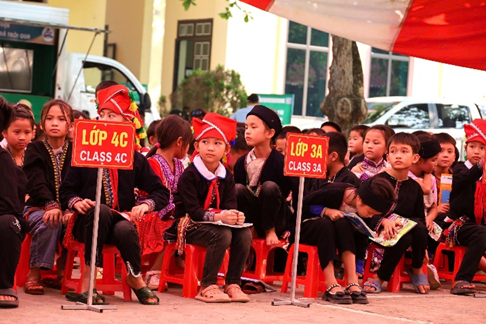
Many specific models and solutions to improve the quality of education in mountainous areas.
Vocational training for ethnic minorities, poor and near-poor households, female laborers, and families who have lost their production land, etc. has received special attention. In particular, propaganda is focused on poor communes and highland communes with many ethnic minotities and unemployed laborers. The business network, especially enterprises in the fields of tourism - services and trade, has developed strongly, attracting more laborers to work at enterprises in the province. At the same time, it has promoted the connection of labor market information, job referral consultation for laborers in the province to work at enterprises outside the province and sending laborers to work across the border under labor contracts. The number of laborers receiving vocational training and job placement has increased compared to the same period last year. Over 400 enterprises and over 52,000 laborers have participated in propaganda and recruitment consultation. Employment creation has contributed to shifting the labor structure. Typically, by 2023, agriculture and forestry will account for 52.7%, industry - construction will account for 15.58%, tourism - services will account for 28.72%.
Sustainable poverty reduction has achieved positive results. According to the survey results, the rate of poor and near-poor households in 2023 decreased 4.43%, exceeding 0.43% of the plan assigned by the province and the Central Government. The province ensures and timely implements state policies to support poor and near-poor households to access basic social services, and accelerates the implementation of component projects of the National Target Program on Sustainable Poverty Reduction for the period 2022-2025.
Emergency assistance and post-disaster support were promptly deployed to stabilize people's lives, resulting in emergency assistance for over 14,600 people.
The cultural and spiritual life of the people is improving gradually, proved by the fact that education, health care, and sports are of attention to the province. The school network is being completed; the scale of education is reasonable to meet the learning needs of the people. In the 2023-2024 school year, the whole province has 610 schools, 8,308 classes with nearly 235,000 students. The quality and effectiveness of education continue to have many clear, comprehensive, and solid changes at all levels of education, especially in mountainous areas and ethnic minority areas, with many specific models and solutions to improve the quality of education. The province also implements inclusive education and priority policies in education for children with disabilities.
The health system operates stably, with investment in facilities. The staff is trained to improve and update their knowledge. 100% of commune health stations meet new rural standards, contributing to the care and improvement of people's health. Moreover, preventive medicine is developed, disease prevention and control capacity is enhanced, and innovation in grassroots health care is boosted.
To better implement social welfare in the coming time, Lao Cai determines to build a social policy system in a sustainable, progressive and equitable direction, constantly improving the material and spiritual life of the people, which contributes to build and protect the socialist Vietnamese Homeland.
The province completed a diverse, multi-layered, comprehensive, modern, inclusive, and sustainable social welfare policy; created opportunities for people, especially the poor, people in difficult circumstances, and people living in areas with particularly difficult socio-economic conditions to access basic social services, especially in health care, education, housing, and information.
Lao Cai sets a goal by 2030: Ensuring that 100% of people with meritorious services and families with meritorious services to the revolution are cared for in terms of material and spiritual lives, and enjoying a standard of living from average to above average compared to the living standards of the community where they reside.
The general unemployment rate remains around 1.2%, the urban unemployment rate is below 4%; the rate of trained laborers reaches 80%, the rate of trained laborers with degrees and certificates reaches over 45%.
The rate of households taking care of children under 36 months old, pregnant women, and the elderly in poor and near-poor households eligible for social benefits according to regulations reaches 100%; the province ensures a minimum standard of living for people in difficult circumstances; provides social benefits for poor households who are unable to escape poverty.
Lao Cai builds at least 7,600 social housing apartments for low-income people and industrial park laborers; eliminates temporary and dilapidated houses for poor households, near-poor households, and people affected by natural disasters and climate change; average housing area per capita in the province reaches 27.7m2 of floor space/person.
The minimum rate of people in remote, isolated and border areas enjoying and participating in cultural activities reaches 75%; the minimum rate of communes in ethnic minority and mountainous areas enjoying and participating in cultural activities reaches 80%...
The province developes a flexible, efficient, internationally integrated labor market associated with sustainable employment; improves the quality of social development management associated with ensuring human rights and civil rights.